Strong chemical bonds
| Typical bond lengths in pm and bond energies in kJ/mol. Bond lengths can be converted to Å by division by 100 (1 Å = 100 pm). | ||
| Bond | Length (pm) |
Energy (kJ/mol) |
|---|---|---|
| H — Hydrogen | ||
| H–H | 74 | 436 |
| H–O | 96 | 467 |
| H–F | 92 | 568 |
| H–Cl | 127 | 432 |
| C — Carbon | ||
| C–H | 109 | 413 |
| C–C | 154 | 347 |
| C–C= | 151 | |
| =C–C≡ | 147 | |
| =C–C= | 148 | |
| C=C | 134 | 614 |
| C≡C | 120 | 839 |
| C–N | 147 | 308 |
| C–O | 143 | 358 |
| C=O | 745 | |
| C≡O | 1,072 | |
| C–F | 134 | 488 |
| C–Cl | 177 | 330 |
| N — Nitrogen | ||
| N–H | 101 | 391 |
| N–N | 145 | 170 |
| N≡N | 110 | 945 |
| O — Oxygen | ||
| O–O | 148 | 146 |
| O=O | 121 | 495 |
| F, Cl, Br, I — Halogens | ||
| F–F | 142 | 158 |
| Cl–Cl | 199 | 243 |
| Br–H | 141 | 366 |
| Br–Br | 228 | 193 |
| I–H | 161 | 298 |
| I–I | 267 | 151 |
Strong chemical bonds are the intramolecular forces that hold atoms together in molecules. A strong chemical bond is formed from the transfer or sharing of electrons between atomic centers and relies on the electrostatic attraction between the protons in nuclei and the electrons in the orbitals.
The types of strong bond differ due to the difference in electronegativity of the constituent elements. A large difference in electronegativity leads to more polar (ionic) character in the bond.
Ionic bond
Ionic bonding is a type of electrostatic interaction between atoms that have a large electronegativity difference. There is no precise value that distinguishes ionic from covalent bonding, but an electronegativity difference of over 1.7 is likely to be ionic while a difference of less than 1.7 is likely to be covalent. Ionic bonding leads to separate positive and negative ions. Ionic charges are commonly between −3e to +3e. Ionic bonding commonly occurs in metal salts such as sodium chloride (table salt). A typical feature of ionic bonds is that the species form into ionic crystals, in which no ion is specifically paired with any single other ion in a specific directional bond. Rather, each species of ion is surrounded by ions of the opposite charge, and the spacing between it and each of the oppositely charged ions near it is the same for all surrounding atoms of the same type. It is thus no longer possible to associate an ion with any specific other single ionized atom near it. This is a situation unlike that in covalent crystals, where covalent bonds between specific atoms are still discernible from the shorter distances between them, as measured via such techniques as X-ray diffraction.
Ionic crystals may contain a mixture of covalent and ionic species, as for example salts of complex acids such as sodium cyanide, NaCN. X-ray diffraction shows that in NaCN, for example, the bonds between sodium cations (Na+) and the cyanide anions (CN−) are ionic, with no sodium ion associated with any particular cyanide. However, the bonds between C and N atoms in cyanide are of the covalent type, so that each carbon is strongly bound to just one nitrogen, to which it is physically much closer than it is to other carbons or nitrogens in a sodium cyanide crystal.
When such crystals are melted into liquids, the ionic bonds are broken first because they are non-directional and allow the charged species to move freely. Similarly, when such salts dissolve into water, the ionic bonds are typically broken by the interaction with water but the covalent bonds continue to hold. For example, in solution, the cyanide ions, still bound together as single CN− ions, move independently through the solution, as do sodium ions, as Na+. In water, charged ions move apart because each of them are more strongly attracted to a number of water molecules than to each other. The attraction between ions and water molecules in such solutions is due to a type of weak dipole-dipole type chemical bond. In melted ionic compounds, the ions continue to be attracted to each other, but not in any ordered or crystalline way.
Covalent bond
Covalent bonding is a common type of bonding in which two or more atoms share valence electrons more or less equally. The simplest and most common type is a single bond in which two atoms share two electrons. Other types include the double bond, the triple bond, one- and three-electron bonds, the three-center two-electron bond and three-center four-electron bond.
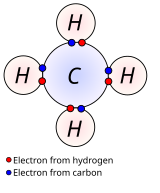
In non-polar covalent bonds, the electronegativity difference between the bonded atoms is small, typically 0 to 0.3. Bonds within most organic compounds are described as covalent. The figure shows methane (CH4), in which each hydrogen forms a covalent bond with the carbon. See sigma bonds and pi bonds for LCAO descriptions of such bonding.
Molecules that are formed primarily from non-polar covalent bonds are often immiscible in water or other polar solvents, but much more soluble in non-polar solvents such as hexane.
A polar covalent bond is a covalent bond with a significant ionic character. This means that the two shared electrons are closer to one of the atoms than the other, creating an imbalance of charge. Such bonds occur between two atoms with moderately different electronegativities and give rise to dipole–dipole interactions. The electronegativity difference between the two atoms in these bonds is 0.3 to 1.7.
Single and multiple bonds
A single bond between two atoms corresponds to the sharing of one pair of electrons. The Hydrogen (H) atom has one valence electron. Two Hydrogen atoms can then form a molecule, held together by the shared pair of electrons. Each H atom now has the noble gas electron configuration of helium (He). The pair of shared electrons forms a single covalent bond. The electron density of these two bonding electrons in the region between the two atoms increases from the density of two non-interacting H atoms.
A double bond has two shared pairs of electrons, one in a sigma bond and one in a pi bond with electron density concentrated on two opposite sides of the internuclear axis. A triple bond consists of three shared electron pairs, forming one sigma and two pi bonds. An example is nitrogen. Quadruple and higher bonds are very rare and occur only between certain transition metal atoms.
Coordinate covalent bond (dipolar bond)
A coordinate covalent bond is a covalent bond in which the two shared bonding electrons are from the same one of the atoms involved in the bond. For example, boron trifluoride (BF3) and ammonia (NH3) form an adduct or coordination complex F3B←NH3 with a B–N bond in which a lone pair of electrons on N is shared with an empty atomic orbital on B. BF3 with an empty orbital is described as an electron pair acceptor or Lewis acid, while NH3 with a lone pair that can be shared is described as an electron-pair donor or Lewis base. The electrons are shared roughly equally between the atoms in contrast to ionic bonding. Such bonding is shown by an arrow pointing to the Lewis acid.
Transition metal complexes are generally bound by coordinate covalent bonds. For example, the ion Ag+ reacts as a Lewis acid with two molecules of the Lewis base NH3 to form the complex ion Ag(NH3)2+, which has two Ag←N coordinate covalent bonds.
Metallic bonding
In metallic bonding, bonding electrons are delocalized over a lattice of atoms. By contrast, in ionic compounds, the locations of the binding electrons and their charges are static. The free movement or delocalization of bonding electrons leads to classical metallic properties such as luster (surface light reflectivity), electrical and thermal conductivity, ductility, and high tensile strength.

Comments
Post a Comment