Bonds in chemical formulas
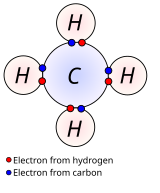
Because atoms and molecules are three-dimensional, it is difficult to use a single method to indicate orbitals and bonds. In molecular formulas the chemical bonds (binding orbitals) between atoms are indicated in different ways depending on the type of discussion. Sometimes, some details are neglected. For example, in organic chemistry one is sometimes concerned only with the functional group of the molecule. Thus, the molecular formula of ethanol may be written in conformational form, three-dimensional form, full two-dimensional form (indicating every bond with no three-dimensional directions), compressed two-dimensional form (CH3–CH2–OH), by separating the functional group from another part of the molecule (C2H5OH), or by its atomic constituents (C2H6O), according to what is discussed. Sometimes, even the non-bonding valence shell electrons (with the two-dimensional approximate directions) are marked, e.g. for elemental carbon .'C'. Some chemists may also mark the respective orbitals, e.g. the hypothetical ethene−4 anion (\/C=C/\ −4) indicating the possibility of bond formation.

Comments
Post a Comment